Early Stage Desert Locusts
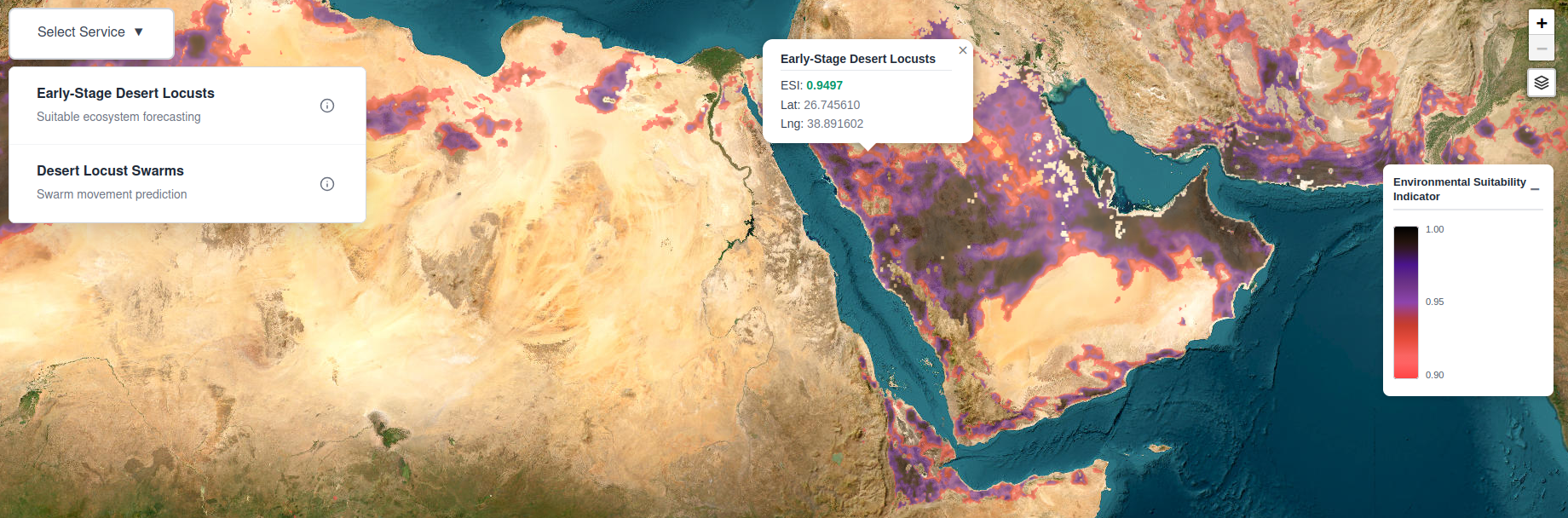
⚠️ Warning: the Experimental mode may be unstable due to temporary Digital Twin data unavailability. Please refer to the FAQ.
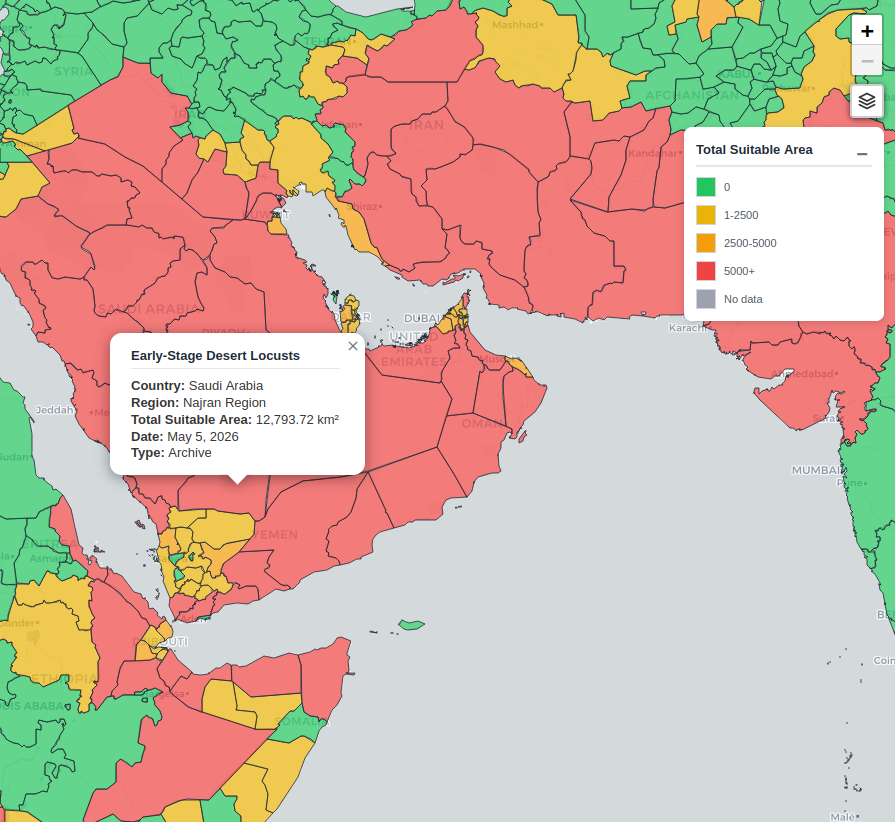
Aggregation per Area
This DLMS feature allows to assess the extent of area potentially impacted by desert locusts in the admin region of interest. This feature, like the rest of the DLMS is available for the geographical domain between North Africa and India. This feature is reserved to Tenancy Members. You can become a DLMS Tenancy Member by contacting us at helpdesk@sistema.at.
Desert Locusts Swarms
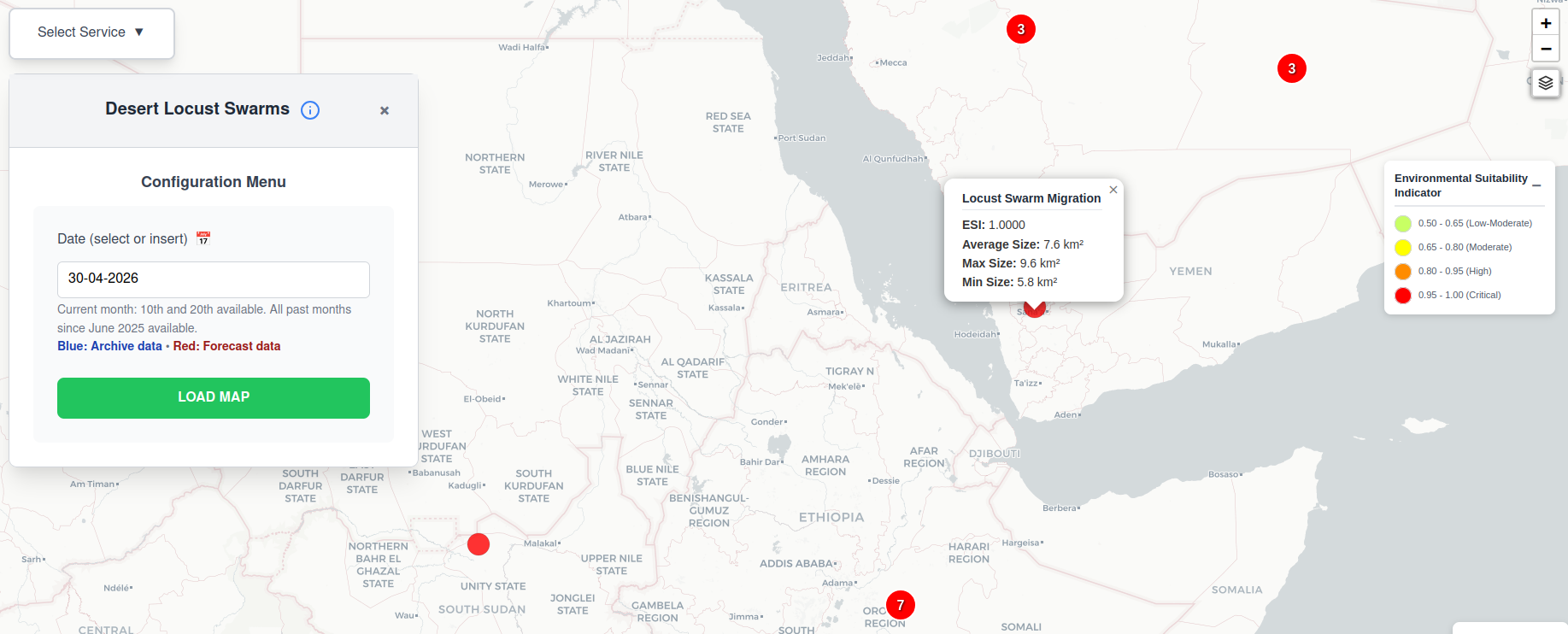
The Locust Swarm Migration service layer is designed for forecasting migration patterns of locust swarms based on the information about the appearance of early-stage locusts provided by the previous layer in combination with climate data from Copernicus and the Climate Change Adaptation Digital Twin.
This layer provides information about both the probability of presence of adult locusts due to migration, as well as the size of the swarm in km 2. The output is visualized as a “bubble-map”, where the colour indicates the probability of swarms. Information about estimated probability and size can be seen by clicking on the area of interest.
Made by SISTEMA
FAQ
About the Service
Q: How do I access the service?
A: You can access the service via web using the link https://dlms.sistema.destine.eu.
Q: Do I need to make a request for upgraded access?
A: No, the DLMS does not rquire upgraded access. However, some features are reserved torenancy users. To request the tenancy, please contact SISTEMA through the DESP support desk or at helpedsk@sistema.at.
Q: Can I access archive data or only forecast data?
A: The DLMS offers both forecast data and archive data from January 2025. If the date you are interested in is not available, you can contact SISTEMA at helpdesk@sistema.at for a customized file provision.
Q: Is the service available through API?
A: Advanced users who may prefer to access the data through API can refer to the API Swagger documentation on the top right side of this web page or to this link: https://platform.destine.eu/services/documents-and-api/api/?service_name=desert-locust-monitoring-service. The same accessibility limitations apply for DESP registered users (regular vs tenancy users).
Q: How do I interpret the results?
A: The service inputs and outputs are explained in service documentation webpage above.
Q: Can I load multiple maps simultaneously?
A:No, this feature is not enabled to guarantee ease-of-use and immediate result of interpretation. However, advanced users can download the outputs through the dedicated API and analyse multiple data locally if they wish.
Q: I cannot load the maps, what can I do?
A: If you are unable to load or download the results, your internet connection and refresh the webpage. If an error message appears, it may mean the service or its dependances may be under maintenance. Due to this there might be some data gaps in the archive. See the section below for more information. If the problem, persist please contact DESP support at https://platform.destine.eu/contact/ or SISTEMA at helpdesk@sistema.at.
Q: I only want to see a specific area of interest. Can I personalize the service?
A: As no personal data is stored, the service cannot be customized, thus the outputs are visualized for the whole affected area between Africa and Asia. However, you can contact SISTEMA for a service instance personalized to your needs at helpdesk@sistema.at.
About Data Gaps
Q: Why are there data gaps in the experimental mode?
A: Data gaps in the experimental mode of the Early-Stage service layer are due to the unavailability of the Extremes DT data at the time of processing. Digital twin data may be temporarily unavailable during maintenance or transition phases initiated by ECMWF. Due to the fact that the Extremes DT has a roll-out of 4 days, and it is not archives, it is not possible to reprocess the Early-Stage outputs for some dates.
Q: Which archive outputs are not available for the experimental mode?
A: The list below shows the data gaps within the Early-Stage data archive. The list will be updated if such gaps should show up again.
2025-02-23 → 2025-02-24
2025-02-26 → 2025-02-27
2025-03-01 → 2025-03-06
2025-03-08 → 2025-03-12
2025-03-14 → 2025-03-15
2025-03-19 → 2025-03-26
2025-03-29 → 2025-04-01
2025-04-03
2025-04-05
2025-04-07 → 2025-04-09
2025-04-12 → 2025-04-13
2025-04-15 → 2025-04-19
2025-04-21 → 2025-04-23
2025-04-25
2025-04-27 → 2025-04-30
2025-05-02 → 2025-05-12
2025-05-14 → 2025-05-24
2025-05-26
2025-05-28 → 2025-06-01
2025-06-03 → 2025-06-09
2025-06-11 → 2025-06-15
2025-06-17 → 2025-06-25
2025-06-27 → 2025-06-30
2025-07-03 → 2025-07-06
2025-07-09 → 2025-07-12
2025-07-14 → 2025-07-23
2025-07-25 → 2025-07-29
2025-07-31 → 2025-08-08
2025-08-10 → 2025-08-20
2025-08-24 → 2025-08-25
2025-08-28
2025-08-30 → 2025-09-03
2025-09-05 → 2025-09-08
2025-09-10
2025-09-12 → 2025-09-13
2025-09-15 → 2025-09-16
2025-09-19
2025-09-30 → 2025-10-04
2025-10-06 → 2025-10-08
2025-10-10 → 2025-10-22
2025-11-14 → 2025-11-21
2025-12-25 → 2026-02-24
2026-03-17
2026-03-23 → 2026-03-25
2026-04-03
2026-04-07 → 2026-04-08
2026-05-12 → 2026-05-18
2026-05-27 → 2026-05-28
2026-06-06 → 2026-06-10