Climate DT

CLIMATE DT

The Destination Earth Climate Change Adaptation Digital Twin provides high-resolution, globally consistent climate information to support climate adaptation.

A new set of simulations is now available, building on upgraded climate models, and impact-sector applications.

This page guides you step by step through all relevant information, including how to access and use the Digital Twin simulations.

Global kilometre-scale resolution

Simulations run at 5–10 km resolution in the atmosphere and ocean capturing local extremes, urban heat islands, and fine-scale ocean dynamics to simulate climate change at the local scale.

60-year multi-decadal simulations

Continuous simulations from 1990–2049 covering the historical period for model evaluation and future projections for adaptation planning.

Storyline Simulations

Storyline simulations replay weather events from the recent past (2017–2025), for example storms and heatwaves, across past, present-day, and +2°C climates to assess how extreme events can unfold in different climate conditions.

3 global climate models

ICON, IFS-FESOM, and IFS-NEMO provide a multi-model ensemble, with output harmonized onto a common HEALPix grid for fast and convenient data access.

Impact sector information

Climate model output is transformed directly into actionable climate impact information for sectors including renewable energy, hydrology, and wildfire risk.

Model evaluation

Simulations are continuously evaluated using the AQUA framework, through comparison with observations, reanalysis and existing climate simulations.

Welcome to your
Climate DT journey

01 INTRO

Understanding the Climate DT

The Destination Earth Climate Change Adaptation Digital Twin (Climate DT) sets up an operational simulation framework providing globally consistent high-resolution climate and impact-sector information, at spatial scales where many of the impacts of climate change and extreme events are observed.

The Climate DT combines global climate models, observations, and sector-specific applications, to deliver actionable insights from global and local scale, supporting applications in areas such as energy, hydrology, and wildfire risk.

Two types of simulations are being produced: global multi-decadal simulations describing the climate evolution under a specific future scenario for the period 1990-2049 and global storyline simulations that explore how extreme events, that occurred across the world during the period 2017-2025, would unfold in different climates.

Multi-decadal climate simulations

The Climate DT Generation 2 multi-decadal global simulations are produced with three state-of-the-art coupled Earth-system models developed by leading European institutions. Each uses different representations for the earth-system components, such as atmosphere, land, ocean and sea-ice. The simulations cover the period 1990–2049, at resolutions comprised between 5 and 10 km across earth-system components, following the SSP3-7.0 scenario. The output is harmonized onto a common HEALPix grid for consistent data access and is available with an hourly temporal resolution.

Multi-decadal climate simulations
IFS-FESOM
Integrated Forecasting System + FESOM2
Atmosphere
5 KM
Ocean
5 KM NG5
Period
1990–2049
Scenario
SSP3-7.0
More information on IFS-FESOM
IFS-NEMO
Integrated Forecasting System + NEMO v4.0.7
Atmosphere
5 KM
Ocean
<9 KM EORCA12
Period
1990–2049
Scenario
SSP3-7.0
More information on IFS-NEMO
ICON
ICOsahedral Nonhydrostatic model
Atmosphere
5 KM
Ocean
5 KM
Period
1990–2040*
Scenario
SSP3-7.0

*information until 2049 will be available soon

More information on ICON

02 Multi-decadal
climate simulations
03 STORYLINE
SIMULATIONS

Storyline Simulations

The global storyline simulations reproduce all recent weather events (2017–2025) across different climate conditions — a cooler past, the present conditions, and a warmer future. These global simulations use IFS-FESOM and spectral nudging techniques to maintain similar large-scale weather patterns while allowing fine-scale atmospheric dynamics, thermodynamic processes, the ocean, land surface and sea ice to respond to different climates. This allows to compare the same extreme event under different climate states, offering deeper insights into how global warming is modifying local weather extremes.

IFS-FESOM
Integrated Forecasting System + Finite-volume Sea Ice Ocean Model nudged to ERA5 reanalysis
Atmosphere
9 KM
Ocean
5 KM
Period
2017–2025
Scenario
SSP2-4.5
More information on Storyline Simulations

Comparison with observations, reanalysis
& existing climate simulations

The Climate DT simulations are continuously evaluated using the AQUA framework. They are compared with observational products and reanalysis datasets for the historical period (1990–2014), as well as with existing climate simulations like CMIP and CORDEX throughout the simulated period.

The second generation Climate DT simulations provide globally consistent climate information with local granularity, at scales where climate change and extreme events are observed. They show a good agreement in terms of global mean climate evolution with observational datasets and CMIP6 simulations. They also more accurately capture characteristics of extremes events at local scale, globally.
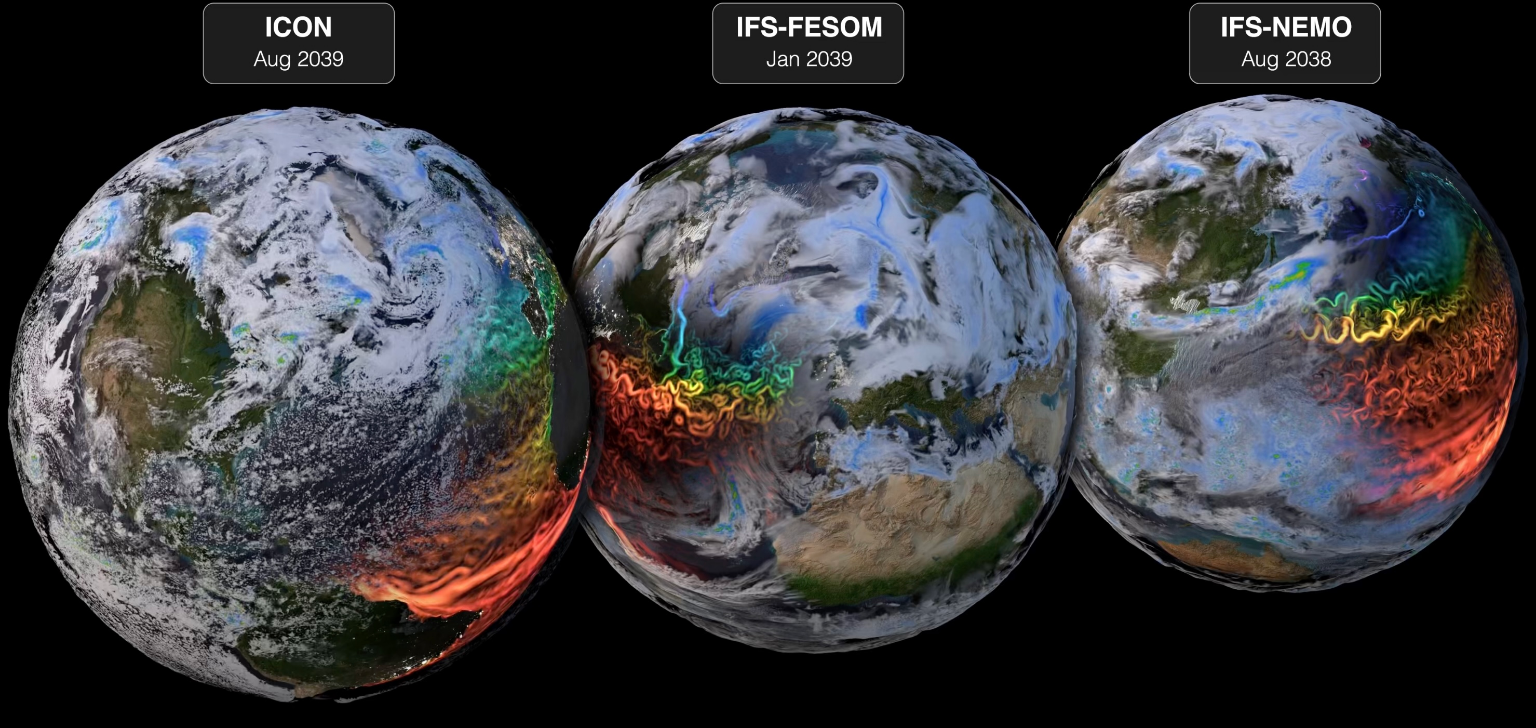
Global information with local granularity
Three Climate DT model systems: ICON, IFS-FESOM, IFS-NEMO

Snapshot of the multi-decadal climate simulations performed with the three climate models, at approximately 5km resolution. Credit: ECMWF
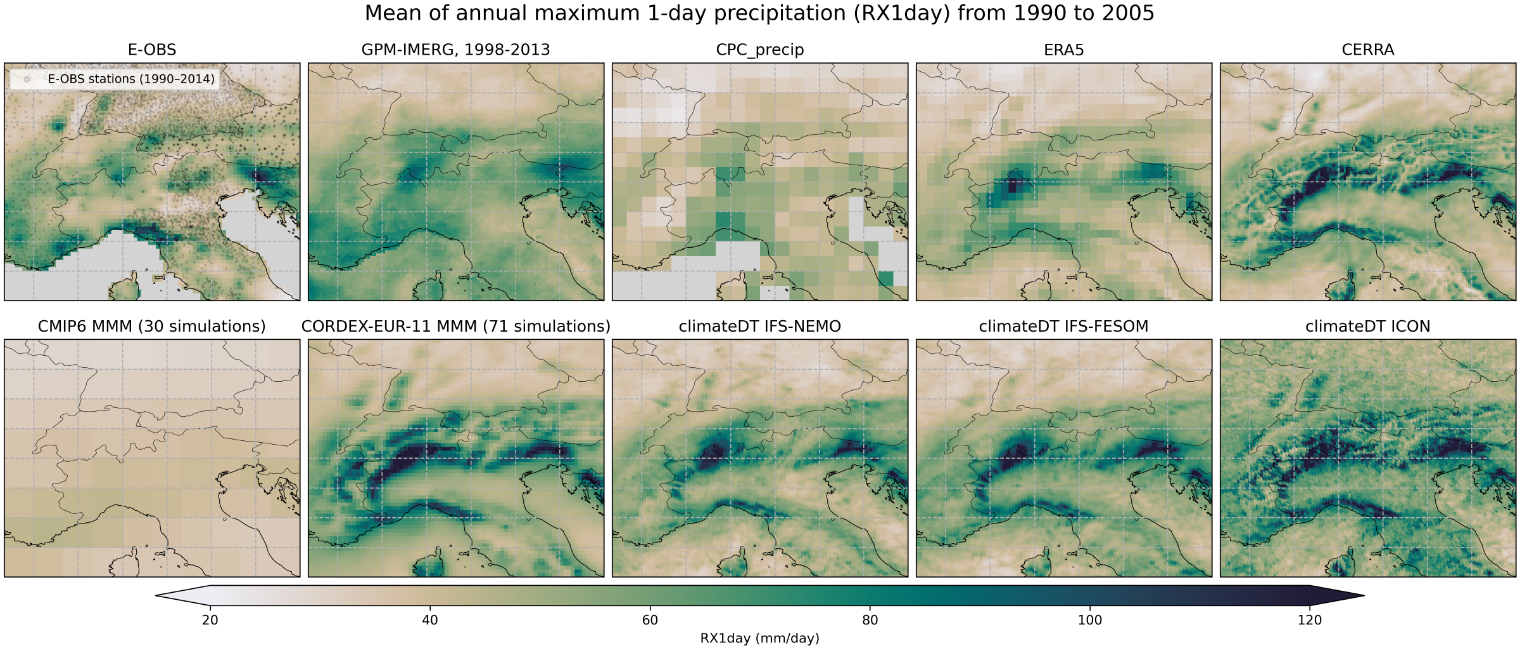
Representing characteristics of extremes precipitation at local scale
Mean of annual maximum 1-day precipitation RX1day

Mean of annual maximum 1-day precipitation (RX1day), over the Alpine region, averaged over the period 1990–2005.

Climate DT models (IFS-NEMO, IFS-FESOM, ICON) compared to observational products (E-OBS, GPM-IMERG, CPC), reanalyses (ERA5, CERRA) and multi-model ensembles (CMIP6 — 30 simulations, CORDEX-EUR-11 — 71 simulations). Computed on the HEALPix H1024 grid (~6.4 km). Credit: ECMWF.

Storyline Case Studies — Past · Present · +2 °C
Storm Boris
September 2024

The km-scale IFS-FESOM ensemble accurately reproduces the spatial structure and magnitude of observed extreme precipitation for this Central European flood event. The three-scenario comparison reveals how the thermodynamic response to warming amplifies precipitation, with the future +2 K scenario showing a clear intensification versus the past conditions.

Paris Heatwave
25 July 2019

The historical IFS-FESOM ensemble faithfully captures spatial gradients and peak temperatures of the observed event, including urban heat island and orographic contrasts invisible in coarser models. Under +2 K, the area exceeding 40 °C expands substantially into Germany and Benelux; in the past conditions, French peak temperatures remain below 35 °C.

read more on multi-model evaluation read more on Climate DT in action
04 MODEL
EVALUATION
05 ACCESS
THE DATA

Register to access Climate DT data

1
Create a free account
Register on DestinE Platform

Registration is free and quick. A DestinE account account gives you access to the platform service catalogue, documentation, and community resources.

2
Apply for upgraded access
Who is eligible?
Public authorities

EU institutions, agencies and bodies, public authorities of EU Member States and Digital Europe Programme Associated Countries.

Academia & research

Public academia and research teams from EU Member States or DEP (Digital Europe Programme) Associated Countries, provided that their domain of activity and intended usage are consistent with the objectives and scope of DestinE. On a case-by-case basis, this category may also include public academia and research teams from third countries, as long as their activities serve the same objectives and are not considered contrary to the Union's strategic assets, interests, autonomy, or security.

Private sector

Private sector based in EU Member States or DEP (Digital Europe Programme) Associated Countries, provided that their domain of activity and intended usage are consistent with the objectives and scope of DestinE. On a case-by-case basis, this category may also include Private sector based in or controlled by entities from third countries, as long as their activities serve the same objectives and are not considered contrary to the Union's strategic assets, interests, autonomy, or security.

3rd country public authorities

Selected third country public authorities following EU's international commitments. Selected public authorities of ESA member states Selected public authorities of ECMWF member states Selected public authorities of EUMETSAT member states Public authorities from countries who have signed a digital alliance or partnership or a similar agreement with the Union Other public sector entities authorised under the AI for Public Good Administrative Agreement

DestinE 3Es (ESA/ECMWF/EUMETSAT) staff

DestinE 3Es (ESA/ECMWF/EUMETSAT) contractors

DestinE 3Es (ESA/ECMWF/EUMETSAT) contractor contributing or participating in the implementation and further development of DestinE.

Users can access Climate DT data in different ways depending on their needs.

Original datasets

The original datasets are available in HEALPix grid on the Data Lake, accessible through HDA or directly via Polytope.

Analysis-ready datasets

Data regridded to a regular latitude-longitude grid and available in Zarr format for a selected set of variables — optimised for cloud-native and analysis-ready access through Earth Data Hub.

Compressed datasets

Lightweight compressed format delivered through the DestinE Streamer — suited for bandwidth-limited environments and quick exploration.

Use the Climate DT data

Explore examples of Climate DT data analysis using Polytope, or directly on the DestinE Platform through Insula notebooks for the Earth Data Hub. Additional notebook examples will be added soon. To integrate Climate DT data into your own workflows on the DestinE Platform, access DeltaTwin.

Climate DT visualisations

Various DestinE services support non-expert users in the discovery and understanding of the Climate DT data and their added value. Below you can find a link to these services, and a preview of the storyline simulations viewer, Prismera.

Coming Soon

Climate DT storyline simulations allow users to explore how all extreme events that occurred between 2017 and 2025 would have unfolded under different climate conditions: a 1950-like pre-industrial climate, present-day conditions, and a world 2°C warmer.

A dedicated storyline viewer supports interactive exploration of these simulations at kilometre-scale resolution, making it possible to compare the same event across climate states and assess how global warming is reshaping regional extremes.

The viewer currently shows 2 different events and new ones will be added regularly.

06 VISUALISE
Get in touch

Ready to work with
Climate DT data?

Whether you have a technical question, need help getting started, or want to contribute — the DestinE team is here to help.

Community resources

Learn more about the Climate DT simulations, underlying models, simulations quality, as well as how to access the data, including practical examples. The Climate DT user guide and the Learning Hub support developing your skills and using the Climate DT data effectively.

Contribute

Let us know which features you are missing in DestinE to use the Climate DT for your activities. Check the roadmap if features under development could support your work.

DestinE Support

Central entry point for any question or request. Whether you need technical help, or advice on adopting specific services, your query is handled directly or routed to the most relevant expert teams across the DestinE ecosystem — ensuring fast, accurate, and coordinated support.

DestinE Training Hub

A collaborative space where the community learns together. Discover tutorials, shared use cases, and hands-on training materials contributed by users and experts, and benefit from collective knowledge to accelerate your work with DestinE.

New to DestinE?

Register on the platform to get a free account — then apply for upgraded access to retrieve Climate DT simulation data.


TERMS AND CONDITIONS FOR DESTINATION EARTH (DestinE) USERS GRANTED UPGRADED ACCESS

The following Terms and Conditions are released by the European Commission and will be applicable for the initial stage of the operation of DestinE, which is still under development.

These Terms and Conditions constitute the entire agreement between the User and the European Commission regarding the use of the DestinE Services for Users Granted Upgraded Access and DestinE Data.

Please read them before registering for the upgraded access to DestinE.

ARTICLE 1: DEFINITIONS

For the purposes of these Terms and Conditions, the following definitions apply:

Academia and Research: Public academia and research teams from EU Member States or Associated Countries, provided that their domain of activity and intended usage are consistent with the objectives and scope of DestinE. On a case-by-case basis, this category may also include public academia and research teams from third countries, provided that their domain of activity and intended usage are consistent with the objectives and scope of DestinE and are not considered contrary to the Union’s strategic assets, interests, autonomy or security.

Associated Country: non-EU country associated to the Digital Europe Programme.

Destination Earth (DestinE): a flagship initiative of the European Commission to develop a highly accurate digital model of the Earth to model, monitor and simulate natural phenomena, hazards and the related human activities.

DestinE Core Service Platform (DestinE Platform): a user-friendly platform that provides a large number of users with evidence-based policy and decision-making tools, applications and services, based on an open, flexible, scalable and evolvable secure cloud-based architecture.

DestinE Data: Earth-system monitoring and prediction system output as provided by Destination Earth Digital Twins, as well as data that are generated by applications for Destination Earth and made available in the DestinE Data Lake.

DestinE Data Lake: a self-standing DestinE system component, interfacing with the Core Service Platform, Digital Twins and Digital Twin Engine, built from geographically distributed physical elements, that references and provides seamless access via GUIs or APIs to data in accordance with the DestinE Data Portfolio. The Data Lake supports near-data processing to maximize throughput and service scalability.

DestinE Data Portfolio: DestinE Data Portfolio is tailored to user needs and composed of federated data, Digital Twin data and DestinE user generated data with a specified and agreed lifecycle.

(DestinE) Digital Twin(s) (DT(s)): Highly accurate replicas of the Earth-system that simulate the system’s behaviour, allowing to monitor and predict environmental change, test scientific hypotheses and adaptation scenarios. DestinE’s DTs combine several cutting-edge Earth-system models and Earth observations as well as advanced data analytics and integration and interoperability with impact sector applications. They are DestinE system components, interfacing with the Digital Twin Engine, offering a seamless production service of actionable knowledge for users that results from the fusion of observational and simulated data of the physical Earth system and of impact-sector relevant information.

Digital Twin Engine (DTE): Software-defined environment to operate DestinE’s DTs and manage their corresponding control and data flows across distributed HPC and cloud computing resources. It provides a common system approach to a unified orchestration of Earth-system Digital Twins. Moreover, it creates a framework for the fusion of observations with Earth-system simulations and the integration of applications targeting specific impact-sectors via selected use cases. The DTE enables the porting and optimization of codes, developing and managing the digital twin workflows, and provides the data handling and model interaction and interactivity capabilities that run on diverse HPC and cloud infrastructures including the Data Warehouse hosted on the data bridges. The DTE concept focuses on interoperability and interactivity and delivers the expected access agility and performance for the digital twins and associated data access.

DestinE Entrusted Entity: an entity implementing respective entrusted tasks in connection with DestinE in accordance with their respective contribution agreements, such as ECMWF, ESA and EUMETSAT.

DestinE Entrusted Entity’s Contractor(s): a legal entity with which a DestinE Entrusted Entity has a contract for provision of services, supplies or works for the implementation of DestinE in accordance with a respective contribution agreement.

DestinE Services for Users Granted Upgraded Access: all services accessible to Users Granted Upgraded Access through DestinE Platform.

EU Emblem: The official emblem of the European Union. Download the EU Emblem and graphical information

Intellectual Property Rights (IPR): any exclusive or non-exclusive right which exist in any intellectual property, in particular (but not limited to) any copyrights, database rights, patents, trademarks, service marks, design rights, or trade secrets together with any benefits which such Intellectual Property Rights give to the holder, in particular (but not limited to) the right to use, copy, modify, correct, adapt, enhance, improve, update, make new releases or new versions of, make derivative works of, offer, sell, lease, rent, license, distribute in any other way against or without payment, display, broadcast, transmit, or make accessible in networks (e.g. Internet, Intranet) the intellectual property in question in whole or in part and any copies thereof.

Member: An individual user affiliated with an entity that belongs to one of the Users Granted Upgraded Access categories. To validate affiliation, the individual user’s email address is used, which shall be an official email address clearly associated with one of the User Granted Upgraded Access. Personal email addresses, such as Gmail, Outlook, or similar, are not permitted for affiliation validation.

Member States: the States which are members of the European Union.

User Granted Upgraded Access: a registered user whose Upgraded Access to DestinE has been validated by the European Commission. Users Granted Upgraded Access are the following categories: Public authorities, Academia and Research, Private sector, in particular SMEs and start-ups, Users having been cleared for access to the EU Artificial Intelligence Factories, Third-country public authorities, DestinE Entrusted Entities’ staff and DestinE Entrusted Entities’ Contractors.

Public authorities: selected public authorities of EU Member States and Associated Countries. These include the EU institutions, agencies and bodies, public authorities of EU Member States and Associated Countries that have been granted Upgraded Access to the DestinE Services for Users Granted Upgraded Access and DestinE Data for official duty activities.

Private sector, in particular SME’s & start-ups: private sector, in particular SMEs and start-ups, based in EU Member States or Associated Countries, provided that their domain of activity and intended usage are consistent with the objectives and scope of DestinE and provided  that they are under control, directly or indirectly, through ownership interest or via other means, as defined in the Chapter IV of Regulation (EU) No 2024/1624 and relevant Union competition law principles, of legal entities or natural persons established within the Union. On a case-by-case basis, this category may also include private sector, in particular SMEs and start-ups, based in or controlled by entities from third countries, provided that their domain of activity and intended usage are consistent with the objectives and scope of DestinE and are not considered contrary to the Union’s strategic assets, interests, autonomy or security.

Third country: any country that is not a member of the EU and is not an Associated Country.

Third country public authorities: selected third country public authorities following EU’s international commitments. These include public sector entities authorised under the AI4Good Administrative Agreement, public authorities from countries who have signed a digital alliance or partnership or a similar agreement with the Union, and selected public authorities from the member states of DestinE Entrusted Entities.

Upgraded Access: access to all DestinE’s (advanced) features and services available on the DestinE Platform to test, help improve and develop the system.

User: User Granted Upgraded Access or its Member.

ARTICLE 2: GRANT OF RIGHTS AND LIMITATIONS

2.1. The European Commission grants the User personal access to the DestinE Services for Users Granted Upgraded Access and DestinE Data strictly for official use within the scope of activities of the User, subject to the User’s acceptance of these Terms and Conditions.

2.2. The Users’ access rights are linked to their personal accounts and are non-transferable. They are not subject to a payment.

2.3 The User may only create and distribute services/applications/tools/data from which the original DestinE Data cannot be retrieved or reverse engineered.

2.4. The User shall not use the DestinE Services for Users Granted Upgraded Access and DestinE Data or any associated data, software, documentation, or other information for any purpose that contradicts the purposes outlined in Articles 2.1 and 2.3 without the prior written consent of the European Commission.

2.5. The User shall not reproduce, distribute, license, transfer, assign, sell, disclose to, or otherwise forward the DestinE Data or any associated data, software, documentation, or other information to any third party without the prior written consent of the European Commission.


ARTICLE 3: OWNERSHIP, INTELLECTUAL PROPERTY RIGHTS, AND ATTRIBUTION REQUIREMENTS

3.1. The DestinE Data remain the exclusive property of the European Union. The User’s rights to use the DestinE Data are specified in these Terms and Conditions, and the European Union retains all rights not expressly granted to the User in this document. The User may be required to clear additional rights if a specific content depicts identifiable private individuals or includes third-party works. To use or reproduce content that is not owned by the European Union, you may need to seek permission directly from the rightsholders.

3.2. The User acknowledges that all Intellectual Property Rights to the DestinE Data belong to the European Union.

3.3. Subject to Articles 3.1 and 3.2, the Intellectual Property Rights related to services/applications/tools/data created by the User using the DestinE Services for Users Granted Upgraded Access and DestinE Data are owned by the User.

3.4.   A User creating services/applications/tools/data using the DestinE Services for Users Granted Upgraded Access and DestinE Data shall mention that they rely on these elements and refer to the European Commission in their distribution, as well as indicate if changes were made to DestinE Data. For avoidance of doubt, ‘changes’ will include but will not be limited to aggregation, transformation, interpolation or integration with other data sources, which results in services/applications/tools/data that are distinct from the DestinE Services for Users Granted Upgraded Access, and DestinE Data and must be clearly identified as such. The User shall not describe, present, or otherwise represent any services/applications/tools/data derived from or based on the DestinE Services for Users Granted Upgraded Access and DestinE Data as original DestinE Services for Users Granted Upgraded Access and DestinE Data. The attribution must be displayed prominently and provided alongside, within, or co-located with the services/applications/tools/data in the form of the following wording: “This service/application/tool/data is created [based on data of the European Union] and/or [using Destination Earth Platform] (but has been modified by [User’s name]).”  The User may be required to include additional attributions if a specific content depicts such a requirement.

3.5. The User accepts all responsibility and liability for the services/applications/tools/data created by the User using the DestinE Services for Users Granted Upgraded Access and DestinE Data.

ARTICLE 4: NON-LIABILITY

4.1. The European Commission shall accept no responsibility or liability regarding any services, data and information on the DestinE Platform.

4.2. DestinE Data are provided without any express or implied warranty from the European Commission as regards their quality, accuracy, completeness, availability, reliability, speed and suitability for any purpose. The European Commission may make changes to their content at any time and will notify the users of these changes on best effort basis.

4.3. By using the DestinE Platform, Services for Users Granted Upgraded Access and DestinE Data, the User renounces any claim for damages against the European Union. The scope of this waiver encompasses any dispute, including contracts and torts claims, that might be filed in court, in arbitration or in any other form of dispute settlement.

ARTICLE 5: EXTERNAL WEBSITE DISCLAIMER AND DATA PROTECTION

5.1. The DestinE Platform website is an external website, which is not owned by the European Commission, and for which the European Commission assumes no responsibility.

5.2. When Users choose to use the above-mentioned external website, they are subject to the cookie, privacy, and legal policies of that external website. The European Commission can instruct the external website to display or include a link to the European Commission’s privacy notice, which shall be identified as such.

5.3. Compliance with applicable data protection and accessibility requirements of external websites is the explicit responsibility of the external website.

ARTICLE 6: USE OF THE EU EMBLEM BY THIRD PARTIES

6.1. The principles of use of the EU emblem by third parties have been set out in an administrative agreement with the Council of Europe. This agreement has been published in the Official Journal of the European Union on 08/09/2012 (2012/C 271/04). According to this agreement, any natural or legal person (“third-party user”) may use the EU emblem or any of its elements, as long as this use:

  1. does not create the impression or assumption that there is a connection between the third-party user and any of the institutions, bodies, offices, agencies and organs of the European Union or the Council of Europe where this connection does not exist;
  2. does not lead the public to believe that the user benefits from the support, sponsorship, approval, or consent of any of the institutions, bodies, offices, agencies and organs of the European Union or the Council of Europe where this is not the case;
  3. is not made in connection with any objective or activity which is incompatible with the aims and principles of the European Union or the Council of Europe or is otherwise unlawful.

6.2. If the use of the EU emblem complies with the above conditions, there is no need to ask for written permission.

6.3. Registration of the EU emblem, or a heraldic imitation thereof, as a trademark or as any other IP right is not allowed.

ARTICLE 7: CHANGES TO TERMS AND CONDITIONS

7.1. The European Commission reserves the right to modify or update these Terms and Conditions at any time without prior notice. The User’s continued use of the DestinE Services for Users Granted Upgraded Access and DestinE Data shall be deemed acceptance of the modified or updated Terms and Conditions.

ARTICLE 8: DURATION AND TERMINATION

8.1. Upgraded access is granted on a perpetual basis, unless the European Commission decides to terminate DestinE, or to terminate this agreement after a six-months prior notice of termination. The User may withdraw from the Upgraded Access at any time without cause.

8.2. Upgraded access shall automatically terminate with an immediate effect if the User is in breach of these Terms and Conditions.

8.3. The European Commission reserves the right to review any Upgraded Access rights previously granted to Users, and to remove such rights if the conditions for Upgraded Access are no longer met.

ARTICLE 9: APPLICABLE LAW AND LEGAL VENUE

9.1. Any dispute arising out of or in connection with these Terms and Conditions shall be settled by mutual agreement between the User and the European Commission. Such effort shall be deemed to have failed when one side notifies the other in writing.

9.2. Where the User is not a DestinE Entrusted Entity, these Terms and Conditions shall be governed by the law of the European Union complemented, where necessary, by the substantive law of Belgium. In the absence of an amicable settlement in accordance with Article 9.1 above, either side may initiate proceedings before the General Court of the European Union in Luxembourg.

9.3. Where the User is a DestinE Entrusted Entity, in the absence of an amicable settlement pursuant to Article 9.1 above, any dispute, controversy or claim arising out of or in relation to these Terms and Conditions, or the existence, interpretation, application, breach, termination, or invalidity thereof, shall be settled by arbitration in accordance with provisions on applicable law and legal venue of a respective contribution agreement between the Commission and the DestinE Entrusted Entity concerned. If the respective contribution agreement between the European Commission and the DestinE Entrusted Entity concerned is terminated or expired, but the respective former DestinE Entrusted Entity and/or its Members are granted User status, then the provisions on the applicable law and legal venue of the given contribution agreement shall continue to govern any disputes arising from such continued use for so long as the former DestinE Entrusted Entity and/or its Members remain User(s).

ARTICLE 10: ACKNOWLEDGMENT

By accepting these Terms and Conditions, the Users acknowledge that they have read, understood, and agreed to be bound by these Terms and Conditions.