Technical Description
The Canadian Forest Fire Weather Index (FWI) system consists of several indices calculated in three steps. Initially, the moisture levels of organic materials are determined using the Fine Fuel Moisture Code (FFMC), the Duff Moisture Code (DMC), and the Drought Code (DC). The FFMC evaluates the moisture content of fine fuels and litter, indicating the likelihood of ignition. The DMC assesses the moisture content of moderately compacted organic layers at medium depth, providing insight into fuel consumption rates. The DC represents the moisture content of deep, densely packed organic layers and reflects the behaviour of slow-burning materials and seasonal variations. Subsequently, two indices—the Initial Spread Index (ISI) and the Buildup Index (BUI)—are derived from these moisture codes. The ISI estimates the potential rate of fire spread, while the BUI quantifies the amount of fuel available for combustion. These indices are then combined to calculate the FWI, which represents potential fire intensity. It is important to note that the FWI relies solely on atmospheric variables, providing an estimate of fire danger under specific environmental conditions. The required input variables include 12 UTC temperature, dew point temperature, and the northward and eastward components of wind at 2 meters, as well as 24-hour accumulated precipitation.
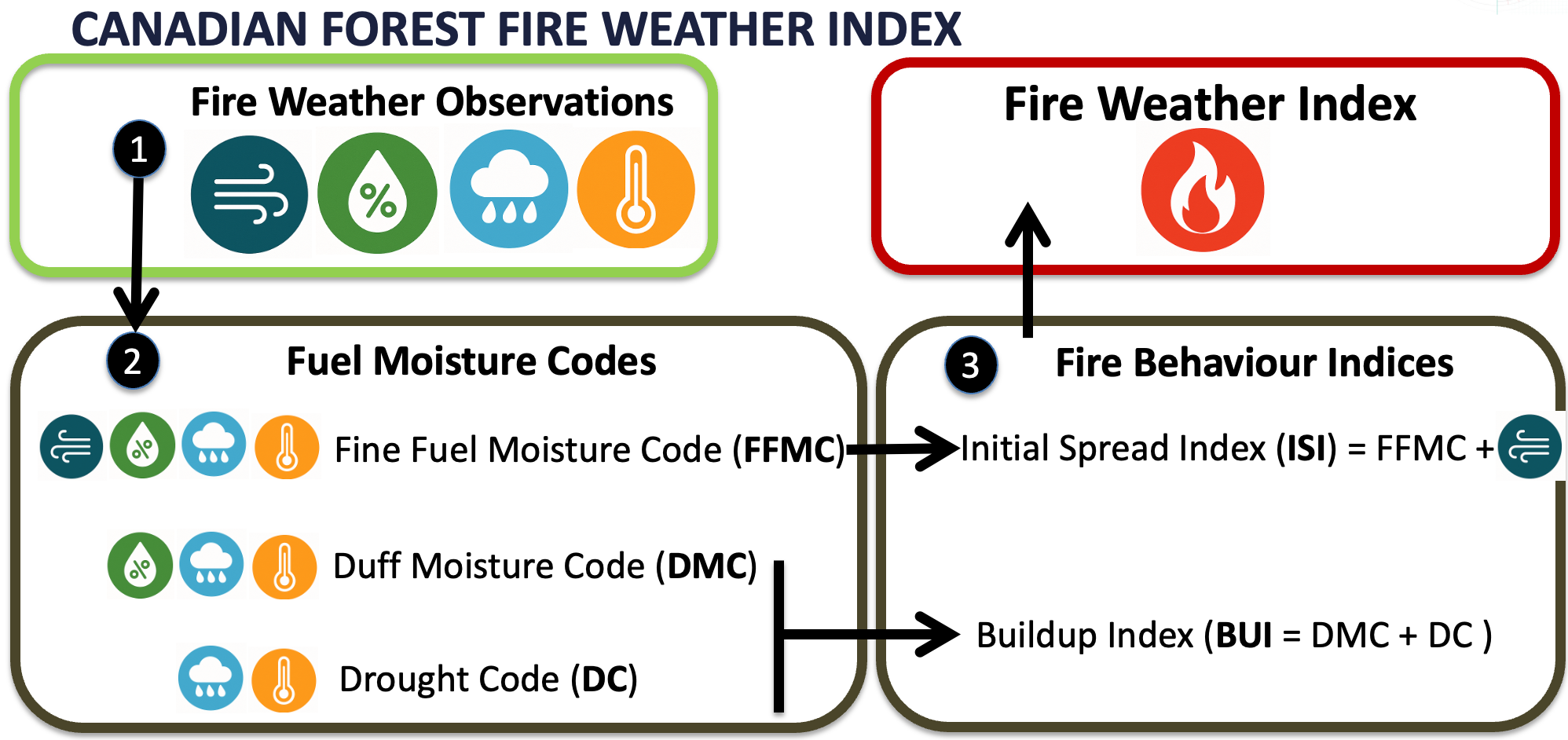
Schematic representation of FWI calculation
Modification of the Original Code
The FWI system was originally developed for Canadian boreal temperate forests (Van Wagner, 1987). To adapt the FWI for global applications, day-length adjustments based on latitude and seasonally varying drying factors are applied. The drying factors are applied such that values for the Southern Hemisphere are derived by shifting Northern Hemisphere values by six months, while near the equator, a constant value is used throughout the year. The application computes the FWI on a daily basis, and the results are stored in NetCDF4 format. The calculation of FWI relies on predefined thresholds in the input variables; therefore, biases in the input dataset can introduce significant errors.
Integration in the workflow
Before the FWI is run, a few contributing processes must be completed.
First, data from the climate models is extracted using the GSV interface, which provides the required atmospheric variables (temperature, relative humidity, and wind speed at 12 UTC) over the global domain. In parallel, the One-pass layer computes the 24-hour accumulated precipitation needed for the FWI calculation. These inputs are used within the FWI application. The main workflow then processes the input data by defining input/output directories, requesting the driving NetCDF files, and performing preprocessing steps such as unit conversions and derivation of variables (e.g., wind speed and relative humidity). The processed data are passed to the core FWI computation module (functions_cal_FWI.py), where the moisture codes (FFMC, DMC, DC) and fire behaviour indices (ISI and BUI) are calculated, and subsequently combined to derive the FWI. The FWI is computed on a daily basis and stored as NetCDF output files. These outputs are then used in a post-processing step to generate annual statistics.
In summary, this procedure represents an end-to-end workflow in which the FWI application runs simultaneously with the input climate model simulations, enabling continuous fire danger assessment as the simulations progress. This ensures a consistent and scalable estimation of fire weather conditions. Finally, the FWI daily and annual statistics output are uploaded to the Data Lake.
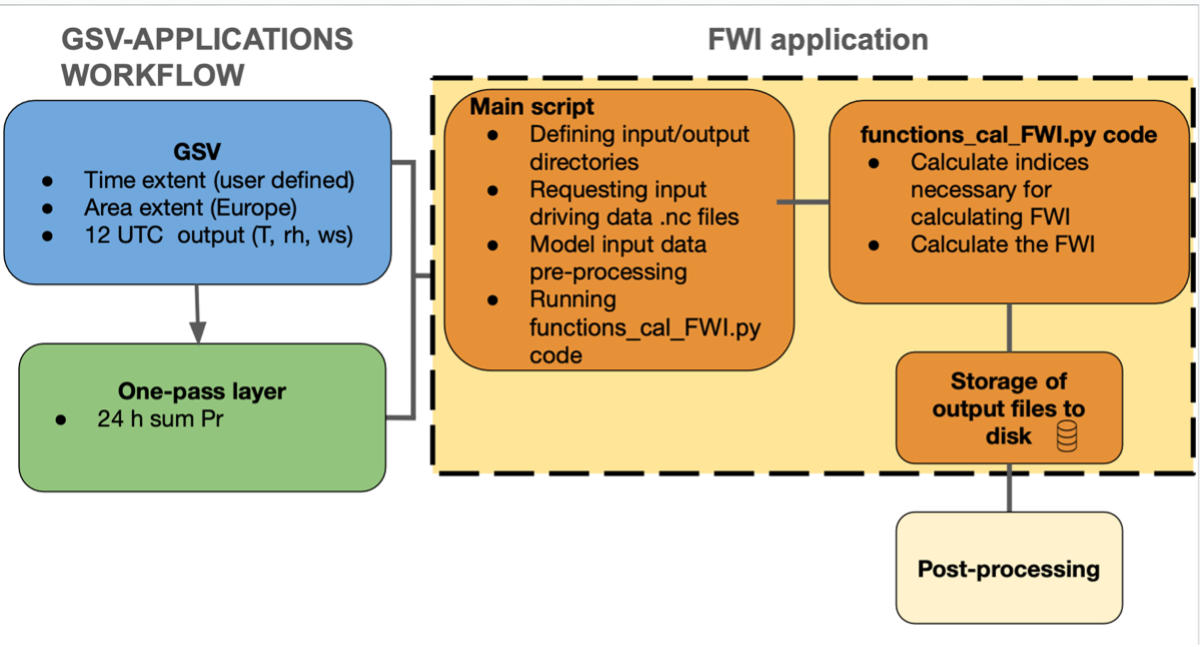
Scheme of the integration of Wildfire-FWI into the Climate DT workflow.